
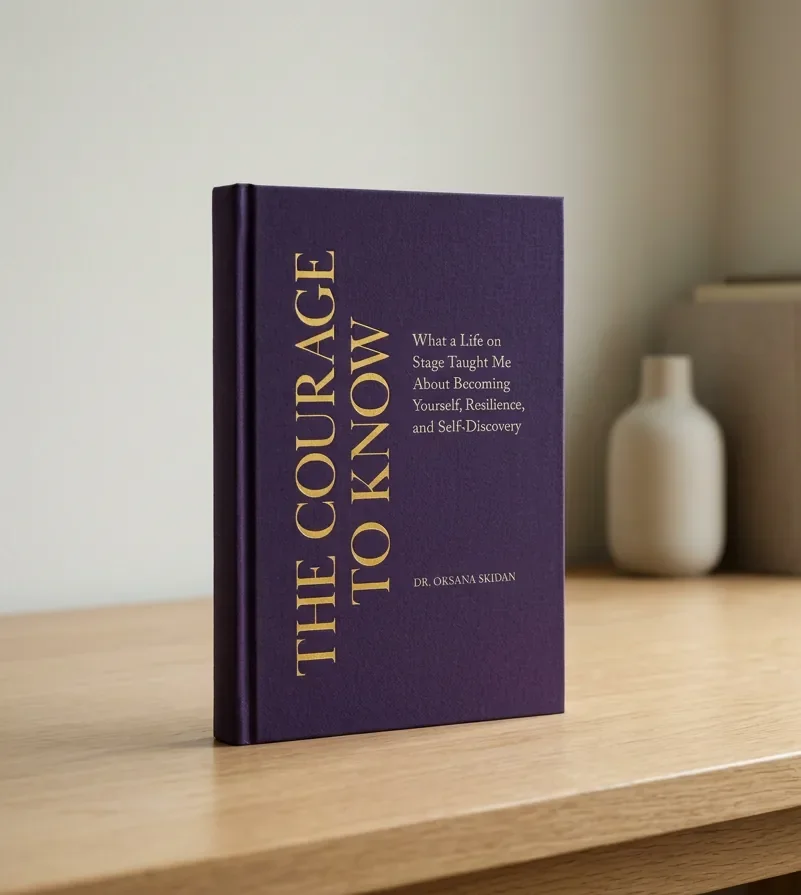
The Courage to Know
Know what to do when doubt, pressure, and perfectionism get in your way.
You replay a conversation long after it ends. Put off something you want because you don’t feel ready. Achieve what you set out
to do—and immediately focus on what you could have done better.
The Courage to Know brings together 32 practical lessons forged through a life of performance, pressure, reinvention, and change. Through personal stories, questions, and concrete practices, each chapter gives you a different way to meet the moments when fear, doubt, perfectionism, or old beliefs get in your way.
For anyone ready to spend less time second-guessing themselves and more time doing what matters.
Find a way forward in the moments that hold you back.
When fear keeps you waiting:
Use the F.E.A.R. framework (Focus, Educate, Act, Repeat) to name what you’re afraid of, prepare for it, and take the next step.
When you keep revisiting what went wrong:
Learn how to regain your attention in the moment, then review the experience without turning it into a verdict on yourself.
When your own rules make life smaller:
Ask “Who said so?” Identify the assumptions behind what you believe you must do—and what you believe you cannot.
When you work hard but struggle to see progress:
Use Keep, Stop, Start to recognize what is working, change what is costing you, and decide what comes next.
When getting it perfect keeps you from finishing—or enjoying it:
Explore how to pursue excellence while leaving room for your judgment, individuality, and pleasure.
Read from the beginning or open the chapter that meets you where you are. You can work with one lesson at a time.
Sneak Peek:
“Listening to the whispers of your body today saves you from the screams of illness tomorrow.”
— Your Body Is Never Silent (Ch.5)
“With a deep breath that matches the tempo of my composition, I raise my hands, ready to play. The first notes are barely out before a sharp voice cuts through the air, echoing off the walls—my teacher, demanding precision.
‘No! No! That’s not right. Start again.’
Her words, real and uncompromising, jolt me back to the start.”
— Introduction
“Our inner voice is not just a reflection of our thoughts in the moment. It’s a layered echo chamber of our
past—full of cultural beliefs, parental messages, personal experiences, and social expectations. Sometimes, when you hear that familiar internal chatter, it’s not even your voice. It might be your mother’s. A coach from childhood. A teacher’s
well-meaning criticism. A stranger’s offhand comment. It’s all in there.”
— Lifelong Dialogue (Ch.16)
“Our language generates emotion. Emotion fuels thought. Thought drives behavior. And behavior shapes the life we build. That’s why every word matters.”
— The Architecture of Words (Ch.29)
“Authentism is not the opposite of excellence. It’s a deeper kind of excellence. One that honors your unique way of thinking, speaking, contributing, and creating.”
— From Perfectionism to Authentism™ (Ch. 26)
I learned these lessons on stage.
I kept using them everywhere else.
As a pianist, I had to learn how to prepare for demanding moments, continue after a mistake, and trust myself when nobody could step in for me.
Years later, through immigration, business, motherhood, career changes, and work in Ukraine during war, I recognized how much I still relied on that training. The circumstances had changed. The lessons had not.
I wrote The Courage to Know to pass those lessons on
to you—with the stories that taught me, the questions they raised, and practical ways to use them in your own life.